
Over the past years, India has evolved from a cost-efficient outsourcing destination into a strategic location for Global Capability Centres (GCCs). Something that started as an exercise in operational efficiency has now transformed into an effective ecosystem. This is where your governance, regulatory alignment and compliance become core parts of your business strategy.
In the current business scenario, no one considers compliance as a regulatory issue; now it is like a strategic asset. A well-structured GCC in India helps its parent company to achieve scalable governance and accelerate digital transformation.
Now we have entered into a new era of cross-jurisdictional complexity. As the Digital Personal Data Protection Act (DPDPA, 2023) comes into its full existence, along with the influence of GDPR and CCPA – GCCs that take early steps get first-hand advantages.
Today, the conversation is not about whether to set up GCC in India or not; it is about how to do it effectively. And this process begins with a clear understanding of the country’s changing regulatory frameworks and aligning with the global standards.
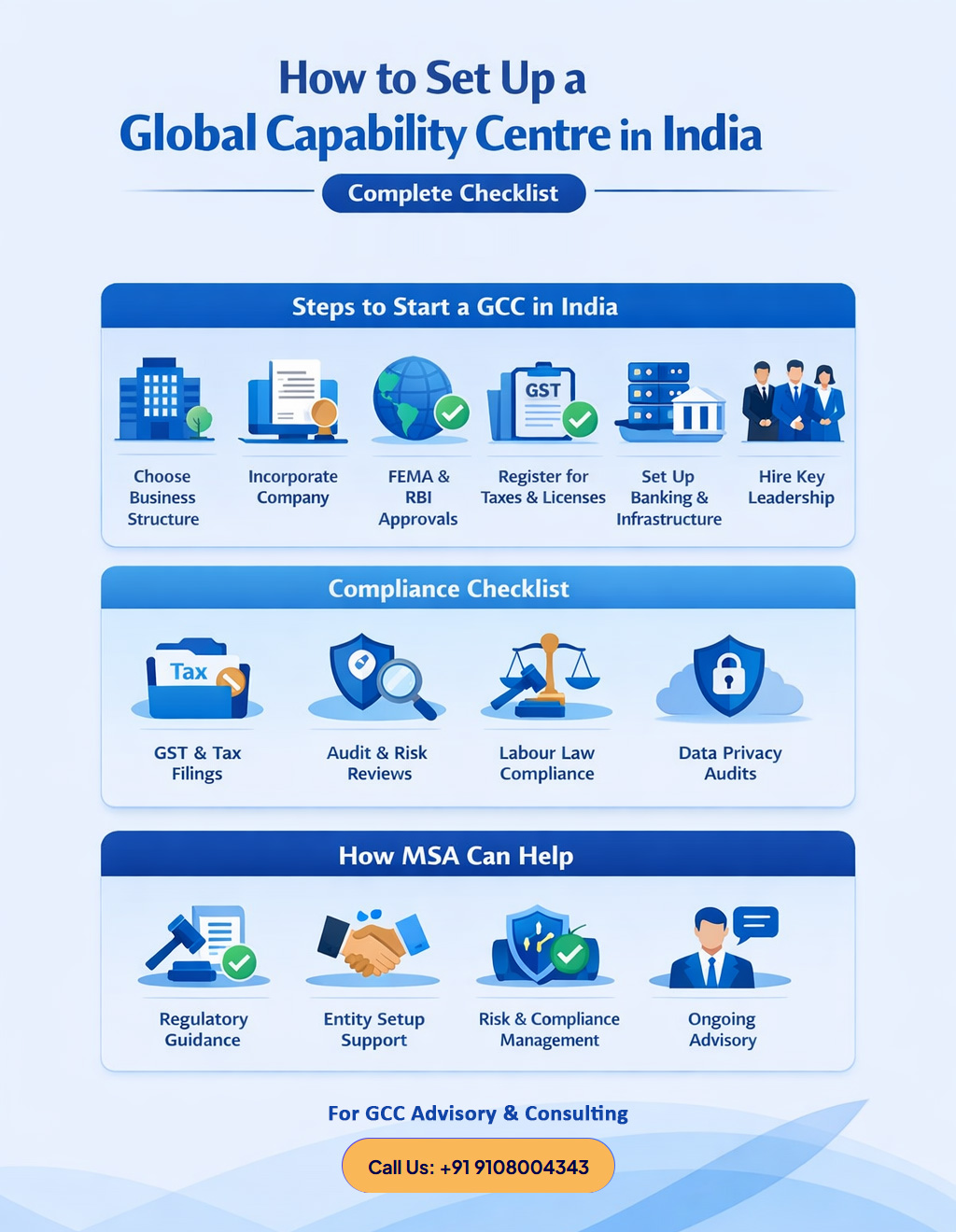
Below we will take a look at – How to Set Up a GCC in India.
Understanding GCCs
When looking back a decade ago, in India, GCCs were set up as a cost-effective option for global businesses – the traditional offshore centres. But today, the narrative has changed completely – they act as a hub for innovation, support and business transformation.
India now hosts around 1700 GCCs that have around 1.6 million professional employees. Bengaluru, Hyderabad and Pune being the hot capitals of the GCC ecosystem. These GCCs are contributing more than $64.6 billion USD to the economy annually. [Source]
If you ask the one factor that differentiates the “old GCC” from the “new GCC” is, its strategic intent. Modern GCCs are like innovation hubs that are leading global R&D, data analytics and digital transformation mandates.
Now we are seeing a shift where global companies rely a lot on Indian GCCs not only for operational delivery but also for driving privacy transformation, technology adoption and process innovation etc. And all these factors make the Indian GCC space place itself beyond being just operationally strong.
Right Way to Build a GCC
Let us take a quick look at the details to build a GCC in India the right way.
Step One – Decide What You Want to Build
See how your centre will act, whether it will be a strategic CoE for innovation or a specialised back office managing data governance and privacy operations. Because your entity structure, be it a liaison office, branch or wholly-owned subsidiary it should mirror your intent.
Step Two – Choose the Right City
Once you know what to build, the next step is to decide where to build. As you can see, Bengaluru leads with tech talent and Hyderabad is core for cybersecurity and life sciences. On the other hand, Pune attracts a balanced workforce across R&D and finance. Each of these locations has its own SEZ benefits and corporate tax advantages.
Step Three – Get Your Compliance Architecture Right
Once the location is finalised, then you have to get started with the basics like the PAN, TAN, GST and RBI registrations under the FEMA. Other than these, there are sector-specific regulations if you are in BFSI, healthcare or telecom.
Step-by-step guide to set up your GCC in India
Setting up a GCC in India is not as complex as you think. If you can get it done in a structured way, you can easily establish your GCC in India.
Here is how to get it right from day one.
1. Choose the Right Business Structure
The first step is to find your entity type. It determines how freely you can operate, hire and move funds.
You can choose from:
- Liaison Office (LO)
- Branch Office (BO)
- Wholly-Owned Subsidiary (WOS)
2. Company Incorporation under MCA
Once you have figured out your business structure, then the next step is legal incorporation:
- Start by reserving your business name using the SPICe+ portal.
- Then you have to draft and file the Memorandum of Association (MoA) and Articles of Association (AoA).
- Then you will be getting your Director Identification Numbers (DIN) and Digital Signatures (DSC) for directors.
- And then you get your Certificate of Incorporation (COI) from the Ministry of Corporate Affairs (MCA).
3. Obtain Approvals under FEMA and RBI
As the investments in GCCs are from a foreign country, you must make sure compliance with the FEMA. This is one of the important laws when you set up your GCC in India. And then you have to file the Foreign Currency-Gross Provisional Return (FC-GPR) with the Reserve Bank.
4. Register for Taxation and Local Compliance
Every GCC must register for the following:
- Goods and Services Tax (GST).
- Professional Tax, Shops & Establishments Act and Trade License (depending on state).
- Provident Fund (PF) and Employee State Insurance (ESI) for labour compliance.
- Import Export Code (IEC) if the centre engages in export of services.
5. Set Up Banking, Accounting and Audit Systems
Once you have sorted out all the above steps, then you can go and open a current account. And you have to integrate accounting systems with ERP or you can use any global reporting tools used by your HQ.
6. Build the Infrastructure (Physical and Digital)
Once legal and tax foundations are set, it is time to go operational:
- Lease or purchase office space in an SEZ, IT Park or GCC-focused business district.
- Set up IT infrastructure compliant with data protection and cybersecurity frameworks.
- Implement information security policies (aligned with NCRF and ISO/IEC 27001).
7. Hire Leadership and Compliance Roles First
Before hiring in volume, appoint key leadership positions:
- Chief Compliance Officer (CCO)
- Data Protection Officer (DPO)
- Chief Financial Officer (CFO)
- Head of Operations / GCC Director
8. Develop Internal Policies and Governance Manuals
Every GCC should maintain:
- Code of Conduct and Ethics Policy
- Data Privacy & Cybersecurity Policy
- Whistleblower & Anti-Bribery Policy
- Workplace Safety & PoSH Policy
Governance and Risk Management – Building Trust Through Structure
As you know, incorporating your GCC in India is not about ticking off a checklist. It is a continuous process of creating a governance system. That ensures that all your decisions, processes and policies are in line with local legal standards.
Here is how successful GCCs build that trust through structure:
1. Establish a Centralised Governance Model
As a GCC in India, you are supposed to set up a GCC Governance Council inside your company. Overseeing everything, operations, finances, compliance and also technology alignment.
2. Create a Risk Register Early
Every GCC faces regulatory, operational and cybersecurity risks. Hence, it is your responsibility to keep a note of all these from day one. Always maintain a live register that tracks all the risks, owners, mitigation plans and review cycles.
3. Set Up Internal Audit and Monitoring Mechanisms
At regular intervals (quarterly), you should conduct internal compliance audits to find the gaps at the right time. And take necessary actions without delay.
4. Build a Culture of Data Ethics and Stewardship
For every company, culture is an important aspect and it should start with people. You have to train your employees in data stewardship, ethical data handling and privacy-by-design principles.
5. Align with Global and Local Standards
As a GCC in India, you must make sure that your company’s governance and security policies are meeting the global standards (like ISO/IEC 27001, ISO/IEC 27701).
Post-Setup Compliance
Once you have successfully set up your GCC in India they there are some regulations that you must follow to stay aligned with both Indian laws and global frameworks.
Let us look at those requirements in detail.
Reference Calendar
On a monthly and quarterly basis you must:
- File GST returns (GSTR-1, GSTR-3B).
- Deduct and deposit TDS on payments.
- Conduct internal financial audits – and data privacy audits.
- Review risk register and update mitigation plans.
- Submit EPF and ESIC returns.
And on a half-yearly or annual basis you must:
- File income tax returns and Form 3CEB (Transfer Pricing).
- Conduct statutory audit and board review meetings.
- Renew labour law registrations and PoSH compliance reports.
- Perform Privacy Impact Assessments (PIAs) and cybersecurity audits.
- File Annual Returns (Form AOC-4, MGT-7) with MCA.
Related Service: GCC Advisory and Consulting Services
Final Thoughts:
In India, every successful GCC have laid their foundations with a vision. Everyone aims to build something that stands for more than cost or convenience. As we know, now we are not just a country that offers talent and technology. Instead, we have become a strong framework of trust, data integrity and compliance.
Hence, start your GCC with the right governance mindset and an early focus on ethics and regulation. If so, we guarantee you that your GCC will evolve into a global powerhouse. A place where innovations help in scaling, compliance builds credibility and strategy drives lasting impact.
Need help with setting up GCC in India? Contact us today!
Author Bio: